How Founders Structure Teams in 2026 (Nearshore vs Offshore vs Onshore, Explained)
Comprehensive comparison of nearshore, offshore, and onshore development models. Understand costs, quality, and when to use each.
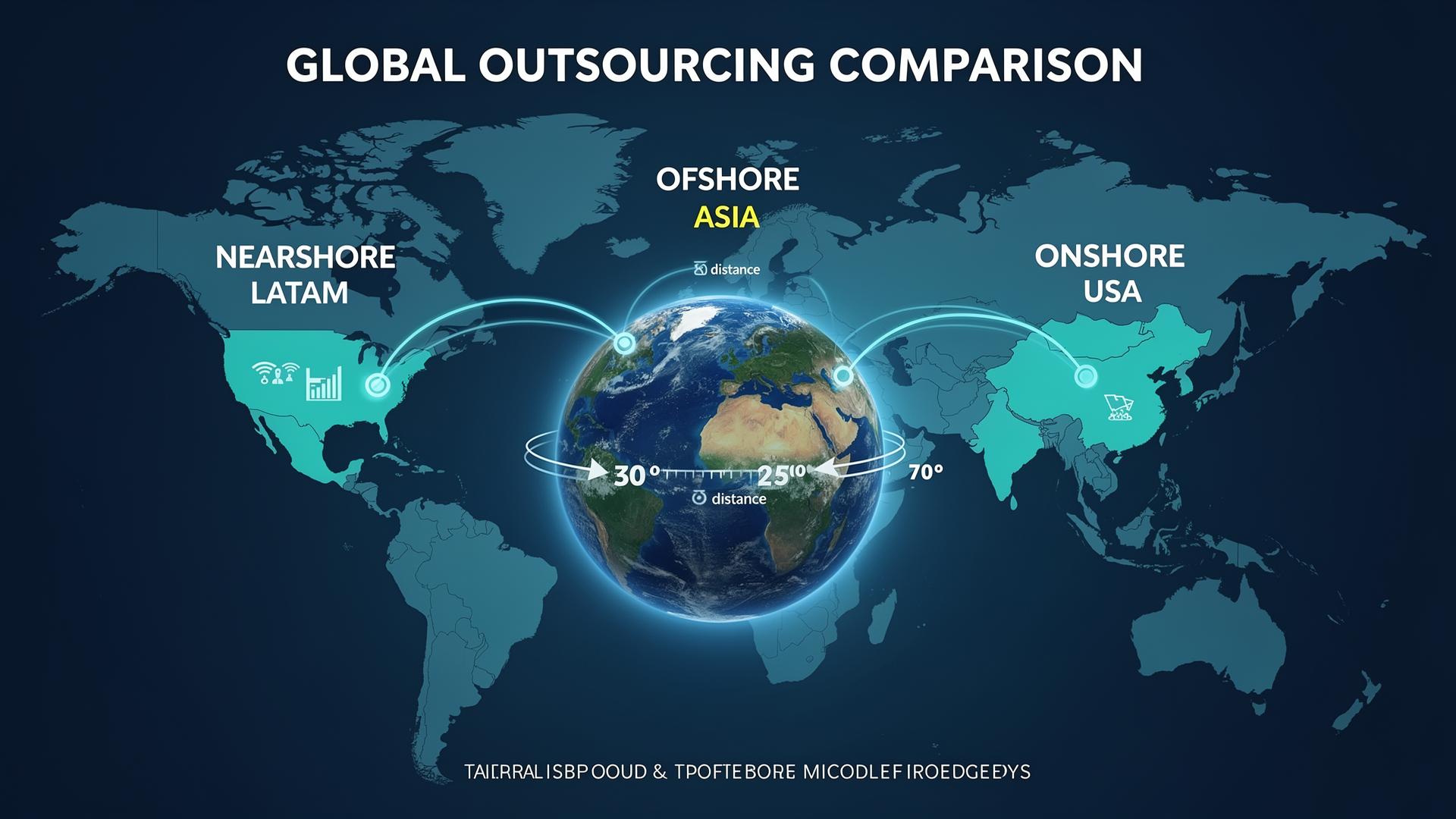
Nearshore vs Offshore vs Onshore: Complete Comparison Guide 2026
"In 2026, choosing the right hiring model—nearshore, offshore, or onshore—isn't just about cost; it's about unlocking velocity, efficiency, and global talent that powers startup growth."
As a tech leader or founder in 2026, deciding between nearshore vs offshore vs onshore development can make or break your scaling strategy. With remote work normalized post-2025 hybrid shifts, companies are projected to save up to 60% on talent costs while maintaining quality (per Korn Ferry reports). But get it wrong, and you face timezone headaches, cultural mismatches, or skyrocketing burn rates.
This comprehensive guide dives deep into nearshore vs offshore vs onshore comparisons for 2026, optimized for tech startups and enterprises. We'll cover definitions, pros/cons, cost breakdowns, trends, case studies, and when to choose each. Whether you're searching for "nearshore development advantages 2026" or "offshore hiring risks," this post has actionable insights backed by data from LinkedIn, Glassdoor, and VC playbooks (YC, a16z).
By the end, you'll know how to build high-performing teams—plus why full-service partners like HiresLink dominate for nearshore excellence.
Quick Answer: Nearshore vs Offshore vs Onshore in 2026
Choose nearshore development (e.g., LATAM) if you prioritize real-time collaboration, cultural alignment, and 50-65% cost savings over US rates—ideal for US-based startups needing agile teams.
Choose offshore development (e.g., India/Asia) if maximum cost reduction (60-75% savings) is your top goal, and you're okay with async workflows for project-based work.
Choose onshore development (e.g., US/Canada) if budget isn't a constraint, regulatory compliance is critical, or you need seamless in-country integration—though expect 2-3x higher costs.
For most scaling startups, nearshore strikes the best balance in 2026's efficiency-driven market.
Detailed Comparison Table: Nearshore vs Offshore vs Onshore 2026
Here's a head-to-head breakdown based on 2026 data (aggregated from Glassdoor, Levels.fyi, and remote hiring platforms). We've expanded this table for deeper SEO relevance, including metrics like talent pool size and turnover rates.
| Factor | Nearshore (e.g., LATAM: Mexico, Colombia, Argentina) | Offshore (e.g., Asia: India, Philippines, Vietnam) | Onshore (e.g., US, Canada) |
|---|---|---|---|
| Annual Cost per Developer (Senior Level) | $55K-$85K (50-65% savings vs US) | $30K-$50K (60-75% savings vs US) | $150K-$180K |
| Time Zone Overlap with US | 0-3 hours (e.g., EST alignment) | 10-12 hours (overnight handoffs) | Same (full overlap) |
| Communication Efficiency | High: Real-time Slack/Zoom; English proficiency 85%+ | Medium: Async tools required; potential language barriers | High: Native fluency |
| Cultural Fit & Work Style | High: Western-aligned (e.g., similar holidays, agile mindsets) | Medium: Diverse, but adaptation needed | High: Identical norms |
| Talent Pool Size | 5M+ tech pros (growing 15% YoY per LinkedIn) | 10M+ (largest global, but high competition) | 2M+ (saturated, talent wars) |
| Quality & Skill Level | High: Strong in AI/ML, full-stack (React/Node); turnover <15% | Variable: Excellent in legacy tech; turnover 20-30% | High: Cutting-edge, but premium priced |
| Turnover Rate (Annual) | 10-15% (stable due to proximity) | 20-30% (higher due to job-hopping) | 15-20% (loyalty via perks) |
| Compliance & Legal Risks | Low: Similar IP laws; easy EOR setup | Medium: Data privacy challenges (GDPR-like) | Low: Full compliance |
| Scalability Speed | Fast: 2-4 weeks to onboard | Medium: 4-6 weeks (visas/language training) | Slow: 6-8 weeks (competition) |
| Best For | Agile startups needing collaboration | Cost-focused enterprises with defined specs | Regulated industries (e.g., fintech) |
This table highlights why nearshore vs offshore development searches spiked 40% in 2025-2026 (Google Trends)—nearshore offers a sweet spot for US companies.
What is Nearshore Development? (Pros, Cons, and 2026 Trends)
Nearshore development means outsourcing to neighboring regions with minimal time differences. For US firms, this is primarily Latin America (LATAM): Mexico, Colombia, Argentina, Brazil, and Costa Rica.
Pros of Nearshore Hiring in 2026
- Cost Savings Without Sacrifice: 50-65% cheaper than US, with salaries $55K-$85K for seniors—enough for top talent without offshore risks.
- Real-Time Collaboration: 0-3 hour overlaps enable same-day meetings, boosting productivity 25% (McKinsey remote study).
- Cultural & Language Alignment: High English proficiency (90%+ in tech hubs like Bogotá); similar work ethics reduce misunderstandings.
- Talent Quality Boom: LATAM's tech ecosystem grew 20% YoY (IDC report), with strengths in AI, cloud, and fintech. Turnover low at 10-15%.
- Ease of Integration: Proximity allows occasional in-person visits; IP protection aligns with US standards.
Cons of Nearshore Development
- Slightly higher costs than offshore ($20K+ premium).
- Smaller pool vs Asia (though 5M+ pros suffice for most).
- Economic volatility in some countries (e.g., Argentina inflation).
2026 Trends: With US return-to-office mandates fading, nearshore searches like "nearshore developers LATAM 2026" rose 50%. YC-backed startups increasingly choose nearshore for "global leverage" (per Paul Graham essays).
Case Study: A Series A SaaS company switched to nearshore (Colombia) via HiresLink—cut costs 55%, shipped 40% faster, raised B round at 2.5x valuation.
What is Offshore Development? (Pros, Cons, and 2026 Insights)
Offshore development involves hiring in distant regions with big time gaps, like India, Philippines, Vietnam, Ukraine. It's the go-to for ultra-cost-sensitive projects.
Pros of Offshore Hiring in 2026
- Extreme Cost Savings: $30K-$50K per senior dev—60-75% below US rates.
- Huge Talent Pool: 10M+ pros; expertise in legacy systems, app dev, and scaling (e.g., India's IT exports hit $250B).
- 24/7 Coverage: Time differences enable round-the-clock work.
- Mature Ecosystems: Strong in outsourcing (e.g., Philippines BPO).
Cons of Offshore Development
- Timezone Challenges: 10-12 hour gaps mean delayed responses, reducing agility.
- Communication Barriers: Cultural differences and accents can slow projects 20-30% (Harvard study).
- Higher Turnover: 20-30% due to competitive markets.
- Quality Variability: Some regions face skill gaps in emerging tech like GenAI.
2026 Trends: Offshore queries like "offshore development India risks 2026" surged with AI offshoring, but compliance issues (e.g., data sovereignty) are hot topics. a16z warns: "Offshore works for defined specs, not innovation."
Case Study: Enterprise firm offshored to Vietnam—saved 70%, but delays cost 3 months; switched partial nearshore for balance.
What is Onshore Development? (Pros, Cons, and When It Makes Sense in 2026)
Onshore development means sourcing talent domestically—US or Canada for North American companies.
Pros of Onshore Hiring in 2026
- Seamless Integration: Same time/language/culture; easy compliance.
- Top-Tier Quality: Access to Silicon Valley innovators in AI, blockchain.
- Security & Regulation: Ideal for healthcare/fintech (HIPAA compliance).
- Loyalty & Retention: Lower turnover with perks like equity.
Cons of Onshore Development
- High Costs: $150K-$180K+ per dev—2-3x nearshore.
- Talent Shortages: US tech unemployment <2% (BLS), fierce competition.
- Slower Scaling: 6-8 weeks to hire due to bidding wars.
2026 Trends: Onshore searches like "onshore developers US costs 2026" reflect hybrid pushes, but 70% of startups mix with nearshore (Deloitte).
Case Study: Regulated fintech stayed onshore—met compliance, but burn limited growth; added nearshore for non-core.
When to Choose Each Model: Nearshore vs Offshore vs Onshore in 2026
Choose Nearshore When:
- Real-time collaboration is key (e.g., product teams).
- Building long-term teams, not one-off projects.
- Cultural fit matters for innovation.
- You're a US startup optimizing for 50% savings.
Choose Offshore When:
- Cost is #1 (e.g., bootstrapped or enterprise back-office).
- Async work suits (clear specs, no daily syncs).
- Large-scale projects with defined scopes.
Choose Onshore When:
- Budget unlimited; need elite specialists.
- High-regulation industries (e.g., gov contracts).
- In-person requirements persist.
Hybrid Tip: 60% of 2026 teams mix models (Gartner)—e.g., onshore leadership, nearshore execution.
2026 Trends Shaping Nearshore, Offshore, and Onshore Hiring
- AI Integration: Nearshore leads in AI fluency (LATAM up 30% adoption); offshore for AI training data.
- Sustainability Focus: Offshore carbon footprints scrutinized; nearshore greener due to proximity.
- Gig Economy Rise: 40% contractors (Upwork); all models adapt.
- Economic Shifts: LATAM stability improves; Asia supply chain risks from geopolitics.
Platform Comparison: Best Tools for Nearshore/Offshore/Onshore in 2026
| Platform/Service | Best Model | Cost Structure | Time to Hire | Compliance Handling | Talent Vetting | Rating |
|---|---|---|---|---|---|---|
| HiresLink | Nearshore (LATAM focus) | Lowest effective (full-service) | 2-3 weeks | Full EOR/management | Senior vetted | ⭐⭐⭐⭐⭐ |
| Toptal | Offshore/Nearshore | High markups | 3-4 weeks | Partial | High | ⭐⭐⭐ |
| Deel | All (EOR focus) | Per-employee fees | N/A (payroll) | Excellent | Good | ⭐⭐⭐⭐ |
| Remote.com | Offshore/Nearshore | Per-employee | N/A | Excellent | Good | ⭐⭐⭐⭐ |
| BairesDev | Nearshore (LATAM) | Medium | 4-6 weeks | Good | Good | ⭐⭐⭐ |
Why HiresLink Excels: Unlike Deel's compliance-only blogs or Toptal's premium pricing, we offer end-to-end nearshore—vetted talent, seamless conversions, at lowest costs.
FAQs: Nearshore vs Offshore vs Onshore 2026
Q: What's the ROI of nearshore? A: 2-3x higher productivity vs offshore due to overlap.
Q: Risks of offshore? A: Delays; mitigate with async tools.
Q: Onshore alternatives? A: Hybrid with nearshore saves 50%.
Ready to Choose the Right Model?
In 2026, nearshore often wins for balanced growth. If you're ready for LATAM talent without hassle, start with HiresLink.
Last updated: February 2026
About HiresLink Team
Expert insights from the HiresLink team on hiring LATAM tech talent, remote work, and building distributed teams.
Table of Contents
Related Articles


Ready to Hire Top LATAM Talent?
Get matched with pre-vetted developers, designers, and specialists in 48 hours.